Medical Humanism

Bridging Ethical Economy and Florence’s Heritage
Modern medicine has never been more technically capable, and rarely more impersonal. Escalating costs, algorithmic diagnostics, and market-driven healthcare systems have progressively sidelined the patient as a person. In this article, published in Beyond Issue 9, Dr. Spyridon S. Kogkas of Imagine Heritage (Athens) makes the case for medical humanism as a coherent response: not nostalgia for a pre-scientific past, but a rigorous framework that reconnects clinical practice, economic organization, and civic responsibility.
Florence as Both Precedent and Model
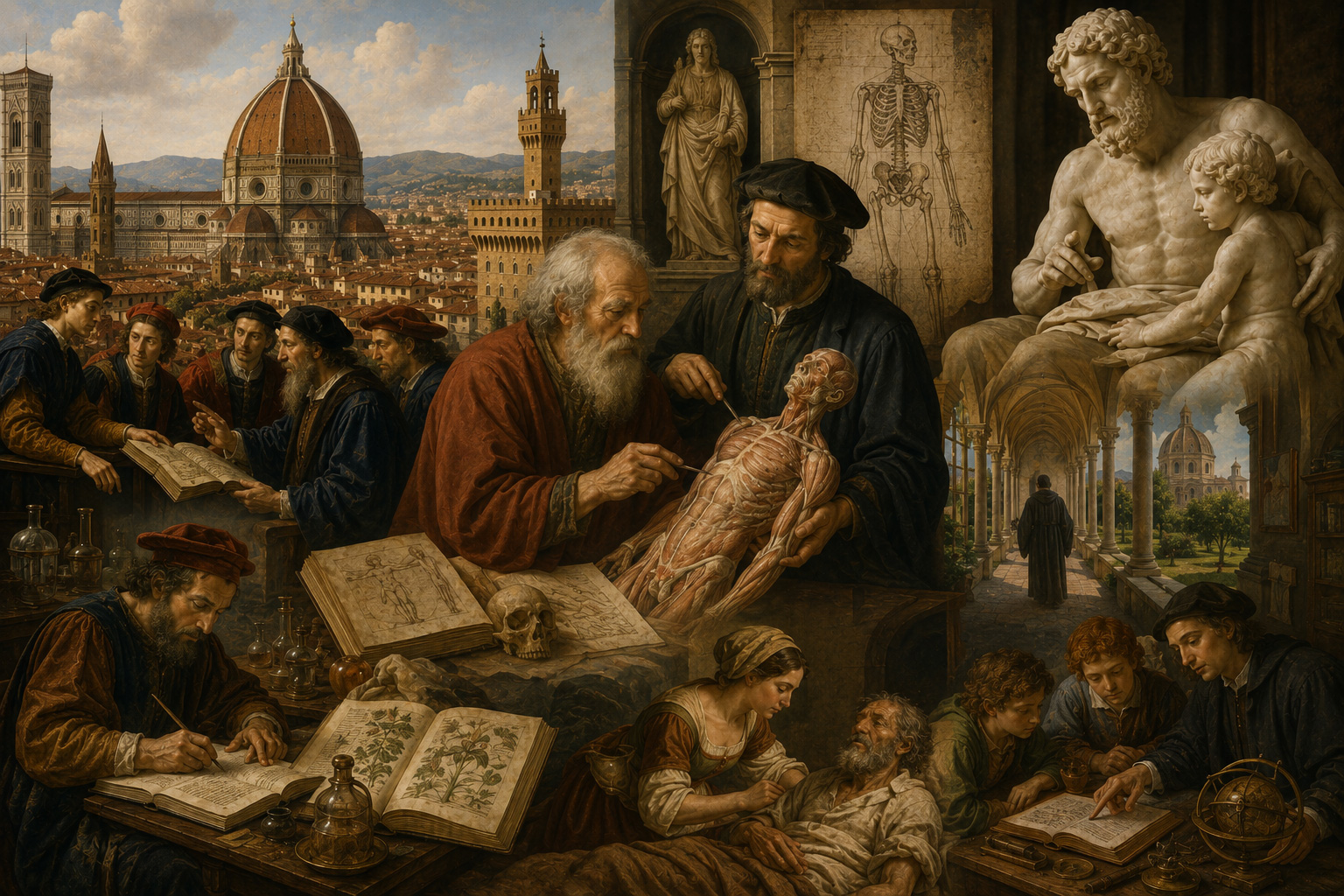
The article’s central argument is historical as much as philosophical. Renaissance Florence offers something rare: a working example of how economic power, ethical commitment, and humanistic knowledge can be made to reinforce one another rather than compete. Institutions such as the Ospedale degli Innocenti, founded in the early fifteenth century, were not simply hospitals; they were civic statements about collective responsibility toward vulnerable populations. The Medici patronage network that sustained them tied artistic and intellectual flourishing to public health and social welfare within a single coherent vision.
Kogkas also traces the influence of Byzantine scholars who arrived in Florence following the fall of Constantinople in 1453. They brought medical traditions emphasizing the integration of empirical observation, moral philosophy, and patient dignity, traditions that merged with emerging Renaissance civic humanism to produce what Kogkas identifies as the foundational logic of humanistic medicine. The physician, in this tradition, is simultaneously a technical expert and a moral agent embedded in the social fabric of the city.
Ethical Economy and the Civil Economy Tradition
The article draws on the civil economy tradition associated with thinkers such as Luigino Bruni, Stefano Zamagni, and the eighteenth-century Neapolitan economist Antonio Genovesi. Civil economy holds that markets function best when embedded in civic structures and moral norms, and that economic activity should serve the common good rather than extract value from it.
Applied to healthcare, this framework produces what Kogkas calls Humanomics: an investment and policy philosophy that places human dignity, community participation, and long-term social value at the centre of economic decision-making. He points to concrete examples, including Italian cooperative banks funding local hospitals, German social impact bonds financing preventive health programs, and American community development financial institutions providing low-interest loans for medical infrastructure in underserved areas. These are not utopian proposals; they are existing mechanisms being underused.
Decentralisation and the Polycentric Model
A substantial portion of the article argues for decentralised, polycentric healthcare structures in which local municipalities, cooperative associations, and community networks share genuine decision-making power. Proximity, Kogkas argues, is not merely an administrative convenience; it is an ethical principle. Local actors are better positioned to understand the cultural contexts and specific needs of their communities, making care more responsive and more genuinely human-centred.
Education as the Starting Point
None of this is achievable, Kogkas argues, without reforming medical education. Drawing on the Renaissance concept of the studia humanitatis, he advocates reintegrating grammar, rhetoric, history, and moral philosophy into clinical training. Approaches such as narrative medicine and ethics-based case analysis already demonstrate measurable capacity to cultivate empathy and moral awareness in students. The capability frameworks of Amartya Sen and Martha Nussbaum provide the theoretical scaffolding: healthcare is not simply the treatment of disease, but the enabling of human agency and flourishing.
Florence’s legacy, in Kogkas’s reading, is not a museum piece. It is an active argument for what medicine can still become.