Offsets and the Path to Carbon Neutrality in Higher Education Study Abroad

The Problem No One Wants to Calculate
Study abroad transforms students. It also burns jet fuel — a lot of it. This tension sits at the heart of a moderated conversation published in Beyond Issue 9, featuring three West Chester University (WCU) scholars: Bradley Flamm, Director of the Office of Sustainability; anthropologist and field school director Michael A. Di Giovine; and education professor Paul Sylvester. Their dialogue is one of the most practically grounded treatments of sustainable study abroad in recent academic literature.
West Chester University’s Carbon Reality
WCU has reduced total campus carbon emissions by roughly 30% since 2010; impressive, given that student enrollment grew nearly 20% in the same period. Yet the university is not on track to meet its carbon neutrality goals, even by 2050. Study abroad travel alone generated over 650 tons of carbon emissions in 2022–23. That number is smaller than commuter traffic, but it is discrete, trackable, and addressable right now.
Why Carbon Offsets for Study Abroad Make Sense
Sylvester makes the case for carbon offsets as triage: not a perfect solution, but the highest-impact, most measurable intervention available. Study abroad flights have a clear beginning and end, making them easier to quantify than heating systems or commuter patterns. He outlines five criteria, drawn from the University of California system, for evaluating offset quality: additionality, accurate baselines, leakage prevention, sound estimation methods, and no double counting. He also references Oxford University principles, which prioritize emission reduction first, then high-quality, verifiable carbon removal.
Critically, the authors are not naïve about offset markets. They acknowledge well-documented problems with low-quality programs and warn against the “low-fat Oreo problem”, where offsets become permission to continue unsustainable practices rather than a genuine corrective.
Sustainability Beyond Carbon: The Three Pillars
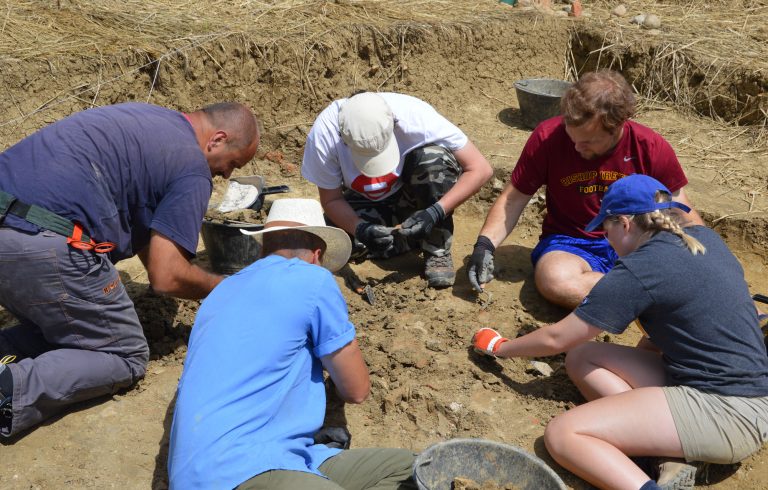
Di Giovine broadens the frame. A truly sustainable study abroad program must balance environmental, economic, and socio-cultural concerns. Offsetting flights while running a superficial, high-turnover program that exploits host communities is not sustainability, it’s greenwashing. His own ethnographic field school in Perugia offers a working model: students are based in one pedestrianized city for six weeks, eat local zero-kilometer food, use public transport, and engage directly with farmers, markets, and food systems. Research by a colleague at James Madison University found that students’ in-country carbon footprints can actually offset transatlantic flights, but only after roughly six weeks of immersive, low-consumption living.
The Systemic Dimension
Sylvester pushes back on individual behavior change as the primary goal. Students also need to understand systemic levers — carbon pricing, cap-and-trade, emissions disclosure — and be equipped to advocate for them. Di Giovine agrees, arguing that deep cultural immersion cultivates the global awareness that drives collective action more effectively than any classroom module.
A Roadmap for Program Directors
The conversation closes with practical recommendations: Global Engagement Offices should educate faculty-led program directors through workshops, offer sustainability incentives, and build offset fees into program costs. The goal is not to eliminate study abroad, it is to make it worthy of the carbon it costs.