Gains and Pains of Short-Chain. Post COVID Reflections on Food Policy and Sustainability

When the Supply Chain Breaks, Food Policy Has to Step Up
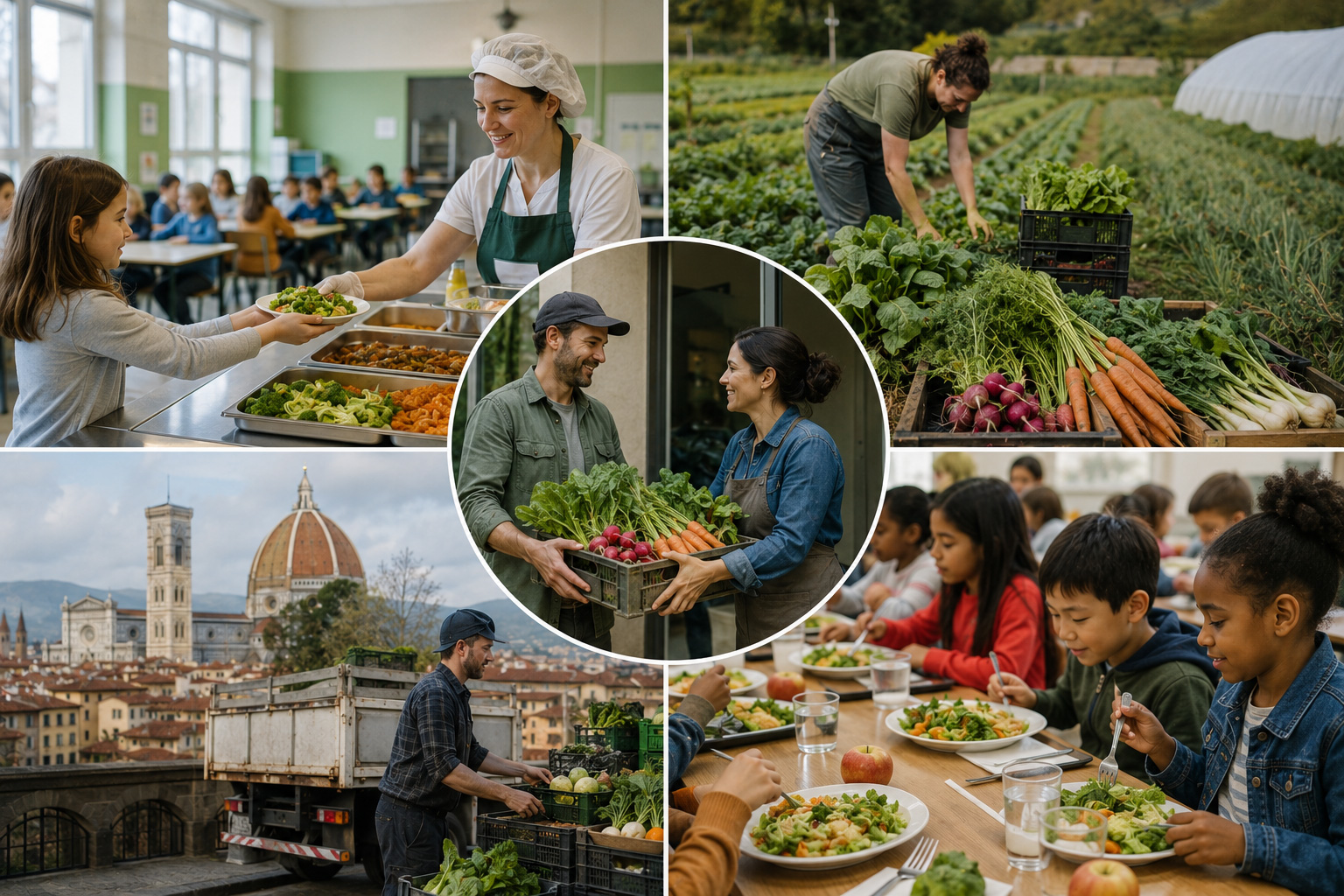
The COVID-19 pandemic did not create the weaknesses in global food systems; it exposed them. In the years since, communities across the US and Europe have accelerated investment in local food networks, particularly for institutional settings like schools. This article by Catherine Nardi, a University of Maryland and ISI Florence alumna and recent Fulbright recipient, presents findings from original research conducted between October 2025 and February 2026, comparing how school feeding programs in Florence, Italy, and Washington, DC procure food through local short-chain suppliers.
What Short-Chain Actually Means
Short-food supply chains (SFSC) involve a minimal number of intermediaries between producer and consumer, typically requiring a local or regional connection to keep pass-throughs low. In Italy, this is less a policy innovation than a cultural baseline; local sourcing is often the default in markets, restaurants, and corner shops. In the US, by contrast, institutional adoption of short-chain procurement is newer, driven largely by specific legislation rather than established food culture.
How the Research Was Done
Nardi conducted face-to-face interviews with school food program staff across three Florentine municipalities (Florence, Scandicci, and Bagno a Ripoli), as well as with contracted caterers, Slow Food Toscana volunteers, local food banks, and agricultural networks. She also interviewed stakeholders in Washington, including DC Public Schools, three catering partners, the Mayor’s Office, the DC Food Policy Council, and several community-based food organizations. Responses were analyzed through four thematic lenses aligned with EU sustainability pillars: policy, health, economics, and environment.
Policy Is the Deciding Factor
The most consistent finding across both cities is that policy drives procurement more than culture, cost, or preference. In Italy, the national Minimum Environmental Criteria (CAM), which became mandatory in 2017, requires a minimum percentage of organic products in school meal programs. In Washington, the 2010 Healthy Schools Act requires at least one locally sourced, unprocessed component per meal, a standard that has since been reinforced through a partnership with the Good Food Purchasing Program.
Without these legal mandates, Nardi finds, institutional short-chain procurement tends to stall.
Where the Two Cities Diverge
Scale shapes everything. Italian municipalities serve smaller geographic areas, allowing school kitchens to prepare meals almost entirely from scratch, including daily bread from local bakeries and fish sourced from the Tyrrhenian Sea and processed on-site. DC’s program operates at a far larger scale, which pushes caterers toward pre-processed local ingredients that can be incorporated more efficiently into high-volume meal production.
Economic pressure also differs. Florentine participants rarely described local products as more expensive than conventional alternatives. DC-based participants consistently flagged higher costs from local suppliers, combined with federal meal reimbursement rates that have not kept pace with rising food prices, as a structural barrier.
What Both Cities Share
Supply constraints are universal. Every municipality in the study reported difficulty sourcing sufficient quantities of local and organic products to meet both demand and policy requirements, particularly during climate-related disruptions to harvests.
Both cities also agree on the upside. DC Central Kitchen described working with 30 to 50 local farms as logistically demanding but worth the return, both financially and for the communities those farms serve.